

Demand for Physicians in Germany
Germany maintains one of the most advanced and well-structured healthcare systems in Europe, supported by modern medical technology, a comprehensive hospital infrastructure, and an extensive network of regional clinics and specialized care facilities. At present, approximately 437,000 physicians provide medical services across the country, sustaining a high standard of patient care within both public and private health institutions. Nevertheless, the sector is facing a growing workforce challenge. An ageing medical workforce, combined with the continuous expansion of health services, has created an increasingly urgent demand for additional medical professionals. The healthcare workforce now exceeds 6.1 million employees, and demographic pressures, particularly the ageing population, are expected to further intensify the need for qualified physicians in the coming years.
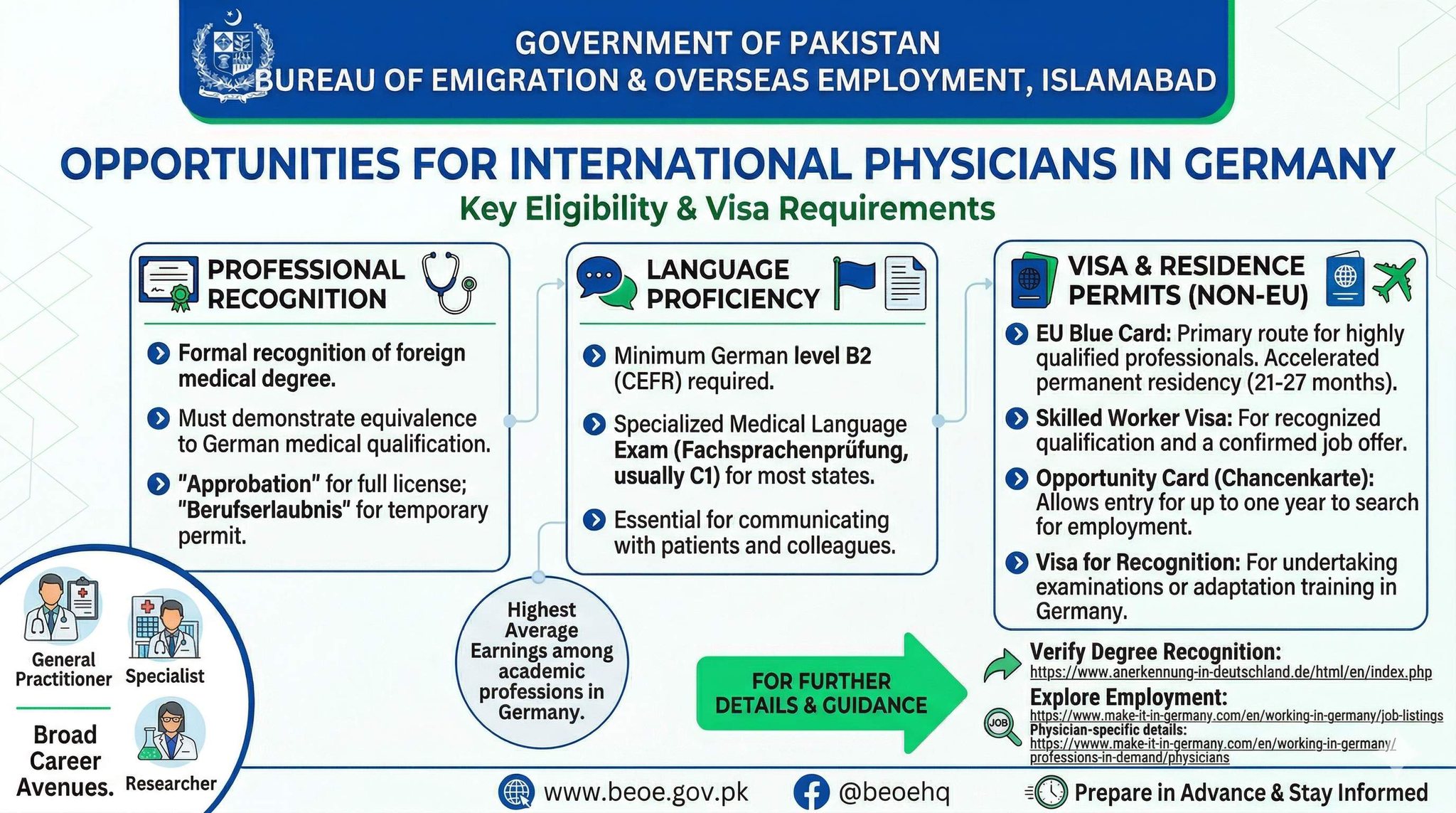
Within this context, Germany offers a broad spectrum of professional opportunities for internationally trained doctors across multiple areas of the healthcare system. Clinical employment remains the most common pathway, with positions available in university hospitals, specialized clinics, regional medical centers, rehabilitation facilities, and geriatric or home-care services. At the same time, structural shortages in primary healthcare have created considerable opportunities for general practitioners and family physicians, particularly in rural regions and parts of Eastern Germany where the transfer or succession of existing medical practices has become a significant policy concern. Beyond clinical practice, the German health sector also provides career avenues in medical research, higher education, public health administration, health insurance institutions, and the rapidly expanding pharmaceutical and medical technology industries. Notably, physicians continue to command the highest average earnings among academic professions in Germany, reflecting both the complexity of the profession and the country’s sustained demand for qualified medical expertise.
Despite these opportunities, the medical profession in Germany is strictly regulated, and all foreign-trained physicians must meet clearly defined legal and professional standards before practising. The first and most critical requirement involves the formal recognition of the applicant’s medical qualification. Foreign degrees must be assessed to determine their equivalence to the German medical qualification. Successful applicants receive the “Approbation,” which constitutes the full and permanent license to practice medicine in Germany without restriction. In cases where a qualification is assessed as only partially equivalent, applicants may initially receive a temporary professional permit known as “Berufserlaubnis,” allowing them to work under defined conditions while completing additional examinations or adaptation measures required for full recognition. This regulatory framework is designed to maintain patient safety while ensuring that international professionals are integrated into the healthcare system through transparent and quality-assured procedures.
Language proficiency represents another fundamental requirement for physicians intending to work in Germany. Effective communication with patients, colleagues, and regulatory bodies is considered essential for safe medical practice. As a general standard, applicants must demonstrate German language proficiency at a minimum of level B2 under the Common European Framework of Reference for Languages. In addition, most federal states require physicians to pass a specialised medical language examination known as the “Fachsprachenprüfung,” which typically requires competency at level C1 and assesses the applicant’s ability to communicate in clinical consultations, medical documentation, and professional discussions. This dual language requirement ensures that physicians are able to function effectively within Germany’s patient-centred healthcare environment.
In addition to academic and linguistic requirements, applicants must satisfy health and character verification procedures before receiving authorisation to practise. Medical fitness must be confirmed through appropriate certification demonstrating that the applicant is physically and mentally capable of carrying out professional responsibilities in a healthcare setting. Furthermore, applicants are required to provide proof of a clean criminal record and demonstrate professional reliability, reflecting Germany’s strict regulatory commitment to safeguarding patient welfare and maintaining public trust in the healthcare system.
For physicians from outside the European Union, entry and employment in Germany also require an appropriate residence permit. Several immigration pathways are available depending on the applicant’s qualifications and employment status. The EU Blue Card is the most prominent residence title for highly qualified professionals and offers an accelerated pathway to permanent residency, which can typically be obtained within 21 to 27 months depending on the applicant’s level of German language proficiency. Alternatively, physicians with recognised qualifications and a confirmed job offer may apply for the Skilled Worker Visa, which permits long-term employment in the country. Germany has also introduced the Opportunity Card (Chancenkarte), allowing qualified individuals to enter Germany for up to one year in order to search for employment, provided they meet certain criteria related to qualifications, work experience, language ability, and age. In situations where a foreign qualification requires further assessment or completion measures, applicants may obtain a visa specifically designed for recognition procedures, enabling them to undertake examinations, adaptation training, or professional integration programmes within Germany.
For individuals considering professional migration to Germany as physicians, a structured preparation process is strongly advisable. The first step involves verifying the recognition status of the medical degree through the official “Recognition in Germany” (https://www.anerkennung-in-deutschland.de/html/en/index.php) portal, which provides detailed guidance on equivalency assessments and responsible licensing authorities. Parallel to this process, prospective applicants are encouraged to begin intensive German language training in their home country to meet both the general and specialised medical language requirements. Once language preparation and qualification recognition are underway, candidates may explore employment opportunities through official platforms such as the “Make it in Germany” job portal (https://www.make-it-in-germany.com/…/worki…/job-listings), where employers frequently advertise positions specifically open to international medical professionals.
After securing a job offer or meeting the criteria for one of the available migration pathways, applicants must apply for the relevant visa through the German embassy or consulate in their country of residence. Upon arrival in Germany, physicians are required to register their residential address within two weeks and complete essential administrative formalities, including enrolment in the national health insurance system.
For comprehensive guidance on professional requirements, Laboure market opportunities, and procedural steps related to medical practice in Germany, detailed and authoritative information is available through the official “Make it in Germany” portal, particularly within the physician-specific information section (https://www.make-it-in-germany.com/…/profess…/physicians) designed to assist internationally trained doctors seeking employment in the German healthcare system.
#OverseasPakistanis #PakistanPride #Pakistan #germany #europemigration #MigrationAwareness #SafeMigration #LegalMigration #Migrate #IrregularMigration #MRC